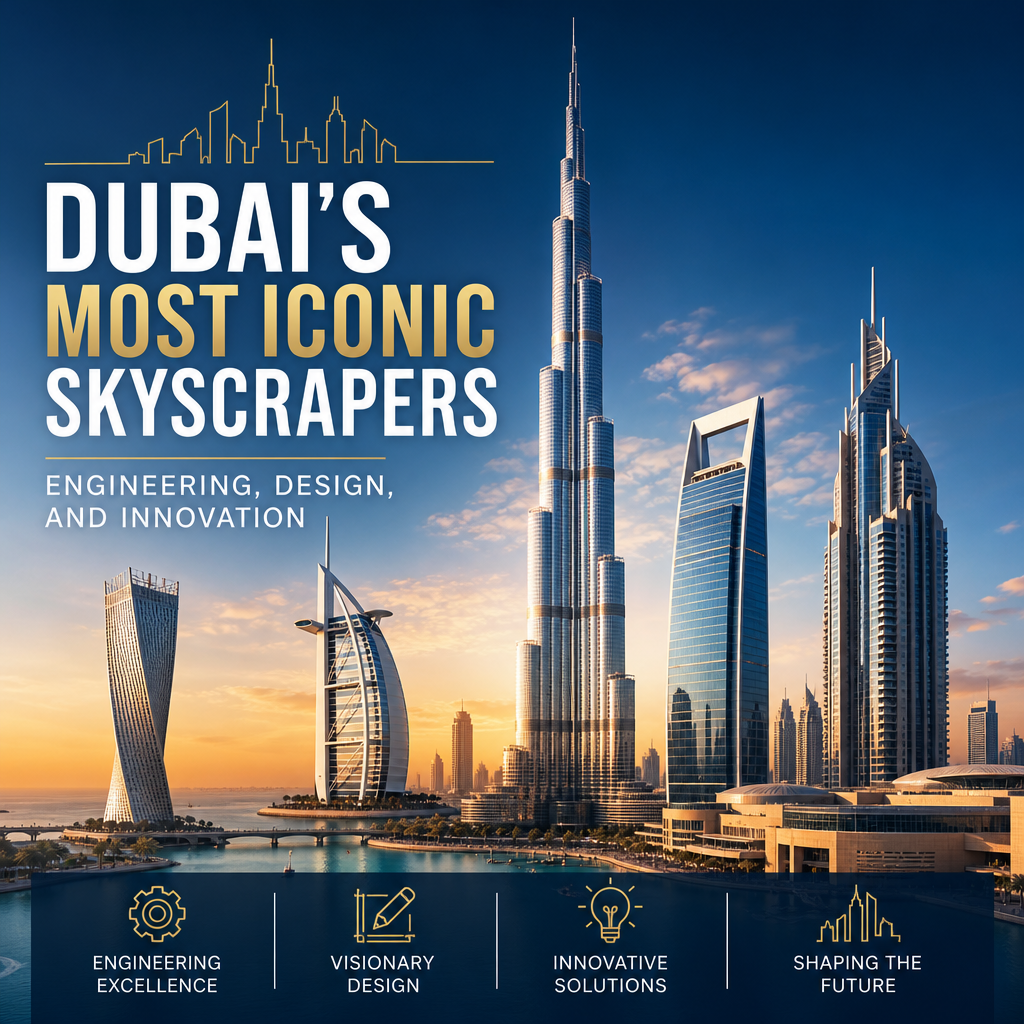
Dubai’s Most Iconic Skyscrapers: Engineering, Design, and Innovation
Inside Dubai’s Most Iconic Skyscrapers: Engineering, Design, and Innovation
Dubai’s skyline tells a story of ambition built in steel, glass, and concrete. In just a few decades, the city has transformed from a low-rise trading port into a global showcase of high-rise architecture. Its most iconic skyscrapers do more than reach toward the clouds: they reflect advances in engineering, respond to a challenging climate, and express a distinctive vision of the future.
Burj Khalifa: Reaching New Heights
The Burj Khalifa is the defining feature of Dubai’s skyline and the world’s tallest building. Completed in 2010, it rises more than 828 metres and demonstrates how careful structural planning can make exceptional height possible.
Its design draws inspiration from the desert flower Hymenocallis. The tower’s central core is supported by three wings, forming a Y-shaped plan. This arrangement distributes weight, improves stability, and helps reduce the impact of strong winds. As the building rises, its setbacks create a spiralling profile that further disrupts wind forces.
The tower’s exterior is covered with reflective glazing and aluminium panels. These materials help manage the intense sunlight while giving the façade its changing appearance throughout the day. Inside, elevators, mechanical systems, and structural supports are organized to serve a building that functions as a vertical city, with residences, offices, hotels, and observation spaces.
Burj Al Arab: Engineering on an Artificial Island
Few buildings are as instantly recognizable as the Burj Al Arab. Shaped like a billowing sail, the hotel stands on a man-made island connected to the shore by a private bridge. Its location and form make it both an engineering feat and a carefully crafted symbol of Dubai.
Building on reclaimed land required extensive preparation. Engineers used large concrete piles driven deep into the seabed to anchor the island and support the structure. The tower’s distinctive exterior is framed by a curved steel structure, while its interior atrium rises through much of the building’s height.
The sail-like silhouette is more than a visual signature. It gives the structure a strong identity against the coastline and reflects Dubai’s maritime heritage. The Burj Al Arab shows how a skyscraper can become a landmark through the combination of technical problem-solving and memorable design.
Cayan Tower: A Twist in the Skyline
Cayan Tower, also known as the Infinity Tower, brings movement to Dubai Marina. The residential skyscraper’s floor plates rotate gradually from the base to the top, creating a full 90-degree twist.
Achieving that form required precise coordination between the tower’s core, façade, and floor slabs. Each level shifts slightly in relation to the one below, while the central core provides stability. The twisting shape also changes the way the building meets sunlight and wind, creating varied views for residents and a constantly shifting silhouette for people outside.
Cayan Tower illustrates how digital modelling and advanced construction methods can turn an ambitious concept into a workable building. Its design is distinctive without relying on extreme height, proving that innovation can come from shape as much as scale.
Museum of the Future: A Building That Looks Ahead
The Museum of the Future stands out for its torus-shaped form, stainless-steel exterior, and Arabic calligraphy cut into the façade. The building’s open centre creates a dramatic contrast between solid structure and void, while the calligraphy acts as both decoration and a source of natural light.
Its complex geometry depended on digital design and advanced fabrication. Because the surface curves in multiple directions, conventional construction methods were not enough. Engineers and architects used detailed computer modelling to coordinate the building’s structure, panels, and openings.
The result is a striking example of how technology can influence both construction and architectural expression. Rather than simply housing exhibits about innovation, the museum makes innovation visible in its own form.
Designing for the Desert Climate
Dubai’s skyscrapers must contend with heat, glare, sand, and high energy demands. Their façades are therefore essential to performance, not just appearance. Reflective glass, shading systems, insulated materials, and carefully planned building orientation can reduce solar heat gain and help control indoor temperatures.
Design teams also consider water use, cooling systems, and the movement of people through tall buildings. In a hot climate, efficient elevators and well-managed mechanical systems are crucial to making high-rise living comfortable. These practical decisions shape the experience of each tower as much as its exterior does.
A Skyline Built on Collaboration
Dubai’s most iconic skyscrapers are products of collaboration among architects, engineers, builders, and specialist manufacturers. Each project presents different challenges, from managing wind at extreme heights to constructing on reclaimed land or producing a complex curved façade.
Together, the towers reveal a city willing to test new ideas while adapting them to local conditions. Dubai’s skyline is not simply a collection of tall buildings. It is an evolving record of engineering progress, design ambition, and the belief that architecture can help imagine what comes next.