

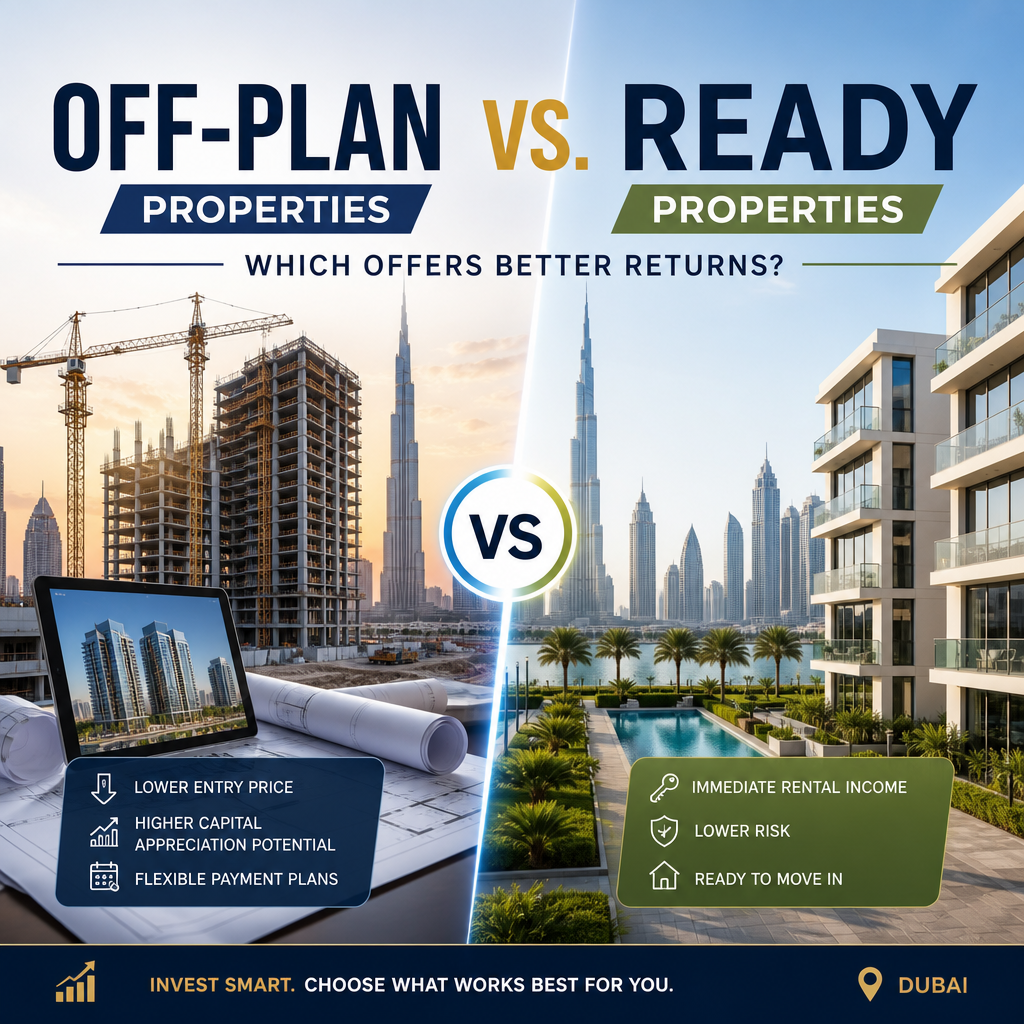
Off-Plan vs. Ready Properties in Dubai: Which Offers Better Returns?
Off-Plan vs. Ready Properties in Dubai: Which Offers Better Returns?
Dubai’s property market offers two main routes for investors: buying a completed home or purchasing one that is still under construction. Each can produce attractive returns, but the better option depends on your budget, investment horizon, risk tolerance, and plans for the property.
There is no universal winner. Ready properties can generate rental income sooner, while off-plan homes may offer lower entry prices and potential gains before completion. Understanding how each investment works can help you choose the right fit.

How Off-Plan and Ready Properties Differ
An off-plan property is purchased before construction is complete, usually directly from a developer. Buyers often pay in stages, with payments linked to construction milestones or scheduled dates.
A ready property is completed and available for immediate use or rent. Investors can inspect the actual unit, review its condition, and assess the surrounding community before buying.
These differences affect both the potential returns and the risks involved.
Potential Returns from Off-Plan Properties
Off-plan homes may appeal to investors seeking capital appreciation. Developers sometimes price units below comparable completed properties to attract early buyers. If demand and market values rise during construction, the property could be worth more by the time it is handed over.
Payment plans can also make the initial purchase more manageable. Rather than paying the full amount upfront, buyers typically spread payments across the construction period. This may allow investors to reserve capital for other needs, though scheduled payments still need to fit their finances.
Benefits of Buying Off-Plan
- Lower initial entry point: Launch prices may be competitive compared with similar completed homes.
- Staged payments: Installments can make it easier to manage cash flow.
- Newer facilities and design: Developments may include modern layouts, energy-efficient features, and shared amenities.
- Potential pre-handover appreciation: A rise in market demand may increase the property’s value before completion.
However, projected appreciation is not guaranteed. A slower market, delayed construction, or an oversupply of similar units can reduce expected gains. Investors also need to wait before receiving rental income, and the final property may differ in practical ways from what they imagined based on plans or show units.
Potential Returns from Ready Properties
Ready properties offer a more immediate route to income. Once the purchase is complete and the unit is prepared, it can be rented out, allowing investors to begin generating cash flow sooner.
Because the property already exists, buyers can inspect its condition, view the precise unit, and evaluate the building and neighborhood. They can also compare current rents in the area, giving them a clearer basis for estimating potential returns.
Benefits of Buying Ready
- Immediate rental potential: There is no construction period to wait through.
- Greater visibility: Buyers can assess the actual home, building, and facilities.
- More predictable income estimates: Existing rental listings and market activity offer useful comparisons.
- Established communities: Schools, transport links, retail, and other services may already be operating.
The trade-off is that ready homes can require a larger upfront payment, particularly in sought-after locations. Investors may also need to budget for maintenance, refurbishment, or service charges. Older properties can be less attractive to tenants if their layouts or facilities no longer match current preferences.
Which Option Offers Better Returns?
The answer depends on what “better returns” means for you.
If your priority is near-term rental income, a ready property is often the more practical choice. It can begin earning rent shortly after purchase, and its income potential is easier to evaluate using actual market evidence.
If you are focused on longer-term capital growth, an off-plan property may offer more opportunity, especially when bought at a competitive price in a location with strong demand. But the potential upside comes with construction, timing, and market risks.
Returns should also be assessed after costs, not just by comparing purchase prices or advertised yields. Consider service charges, maintenance, vacancy periods, furnishing, transaction costs, and any financing expenses. For off-plan purchases, account for the time before completion and the possibility that handover may take longer than expected.
Questions to Ask Before Investing
Before choosing either route, assess:
- What is your investment timeline? A short horizon may favor a completed, income-producing property.
- How much uncertainty can you manage? Off-plan investments involve more variables before the asset is ready.
- Is demand supported by the location? Study access to transport, employment areas, retail, and community facilities.
- Do the numbers work after expenses? Compare realistic net income and costs, rather than relying only on headline projections.
- Can you handle a delay or vacancy? Keep a financial buffer for periods when the property is not earning.
The Bottom Line
Off-plan and ready properties can both perform well in Dubai, but they serve different investment strategies. Off-plan purchases may suit investors seeking staged payments and longer-term appreciation. Ready properties may suit those who value visibility, faster rental income, and more grounded estimates of cash flow.
The strongest investment is not necessarily the newest or cheapest one. It is the property whose location, price, costs, and expected performance align with your goals and financial capacity.
