

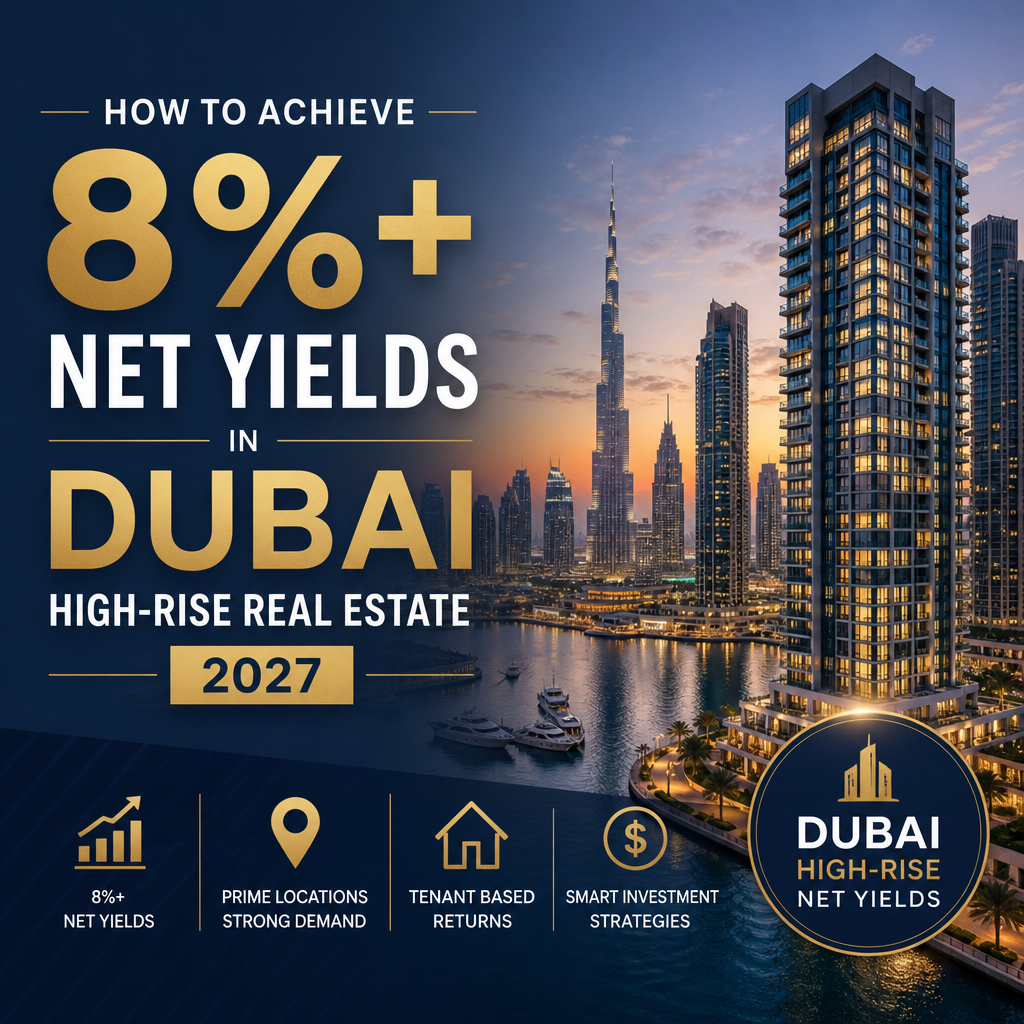
How to Achieve 8%+ Net Yields in Dubai High-Rise Real Estate 2027
How to Achieve 8%+ Net Yields in Dubai High-Rise Real Estate: 2027 Investor Guide
Dubai’s high-rise property market continues to attract international investors seeking rental income, capital growth, and portfolio diversification. However, achieving an 8%+ net yield in 2027 will require more than buying a property in a popular tower.
Gross rental yields can look impressive, but service charges, vacancy periods, management fees, maintenance, financing costs, and transaction expenses can significantly reduce the final return. The key is to select the right building, location, unit type, and operating strategy from the start.

What an 8%+ Net Yield Really Means
Net yield measures the income remaining after property-related operating costs.
A simplified calculation is:
Net Yield = Annual Net Rental Income ÷ Total Investment Cost × 100
Annual net rental income may need to account for:
- Service charges
- Property management fees
- Maintenance and repairs
- Insurance
- Vacancy periods
- Utilities paid by the owner
- Marketing and leasing costs
- Furniture replacement and refurbishment
For example, a property generating AED 120,000 in annual rent may produce much less after AED 25,000 in expenses. Investors should also include the purchase price, registration fees, furnishing costs, and other acquisition expenses when calculating total investment cost.
Choose Locations Based on Tenant Demand
High yields are more achievable in areas with strong, consistent tenant demand rather than simply the most expensive or prestigious districts.
In 2027, investors should examine locations near:
- Metro stations and major roads
- Business districts and employment hubs
- Universities and educational institutions
- Hospitals and healthcare centres
- Tourist attractions and entertainment venues
- Airports and transport connections
Areas such as Jumeirah Village Circle, Dubai Sports City, Dubai Silicon Oasis, Arjan, Business Bay, and parts of Dubai Marina may offer different combinations of affordability, tenant demand, and rental liquidity. The best choice depends on whether the investment strategy targets long-term residents, corporate tenants, or short-term visitors.
Study Rent-to-Price Ratios
A neighbourhood with lower purchase prices but reliable rental demand can outperform a premium district with higher entry costs. Compare:
- Recent sale prices for similar units
- Achieved rents rather than advertised rents
- Vacancy levels
- New supply entering the market
- Annual service charges
- Average days required to lease a property
The goal is to identify buildings where rental income remains strong relative to the all-in acquisition cost.
Select the Right Unit Type
Unit selection has a major effect on net yield. In many Dubai high-rise communities, studios and one-bedroom apartments can deliver stronger percentage returns than larger units because they require less capital and appeal to a broad tenant base.
However, the cheapest unit is not always the best investment. Consider:
- Efficient floor plans with minimal wasted space
- Attractive views and natural light
- Balconies and parking availability
- Proximity to elevators and building facilities
- Furnishing quality
- Layouts suitable for corporate or professional tenants
Units that are easy to furnish, photograph, market, and lease tend to experience shorter vacancy periods.
Prioritise Buildings With Controlled Costs
High service charges can reduce a seemingly attractive yield. Before purchasing, review the building’s annual service fees, maintenance history, sinking-fund requirements, and facilities management standards.
A tower with extensive amenities may appear more appealing, but swimming pools, gyms, valet services, landscaped areas, and premium concierge operations can increase annual ownership costs. Investors targeting 8%+ net yields should compare the value of these facilities against the rent premium they actually generate.
It is also important to investigate:
- Elevator reliability
- Air-conditioning efficiency
- Building age and repair history
- Quality of the homeowners’ association or management
- Parking availability
- Tenant reviews and renewal rates
Use the Appropriate Rental Strategy
Long-term leasing generally provides more predictable income and lower operating complexity. Short-term rentals may generate higher gross revenue, but they also involve furnishing, cleaning, platform fees, licensing requirements, guest turnover, and potentially greater wear and tear.
A practical approach is to compare both strategies using conservative assumptions. Do not base the analysis on peak-season occupancy or unusually high nightly rates.
For short-term rentals, calculate:
- Realistic annual occupancy
- Cleaning and linen costs
- Platform commissions
- Guest supplies
- Management fees
- Licensing and compliance expenses
For long-term rentals, estimate vacancy between tenancies, renewal costs, agent commissions, and periodic maintenance.
Improve Returns Through Value-Add Upgrades
Small improvements can increase rent and reduce vacancy without requiring a major renovation. High-impact upgrades may include:
- Modern lighting
- Durable flooring
- Quality appliances
- Blackout curtains
- Built-in storage
- Professional furniture packages
- Fast internet installation
- Fresh paint and updated fixtures
The objective is not to overcapitalise. Calculate the expected rental premium and compare it with the cost and useful life of each improvement.
Use Conservative Financial Planning
An 8%+ net yield should be treated as a target, not a guarantee. Build a financial model using conservative assumptions, including a vacancy allowance, maintenance reserve, and realistic rent growth.
Investors using financing should also stress-test the property against:
- Higher interest rates
- Lower rental income
- Longer vacancy periods
- Unexpected repairs
- Currency fluctuations
- Changes in short-term rental regulations
A property that only achieves its target return under perfect conditions may not be a resilient investment.
Final Takeaway
Achieving 8%+ net yields in Dubai high-rise real estate in 2027 will depend on disciplined selection and accurate cost analysis. Investors should focus on tenant-driven locations, efficient unit types, manageable service charges, strong building quality, and a rental strategy suited to the property.
The most reliable opportunities are rarely based on headline yields alone. They come from buying at a sensible price, reducing avoidable expenses, maintaining occupancy, and managing the asset professionally over the long term.