

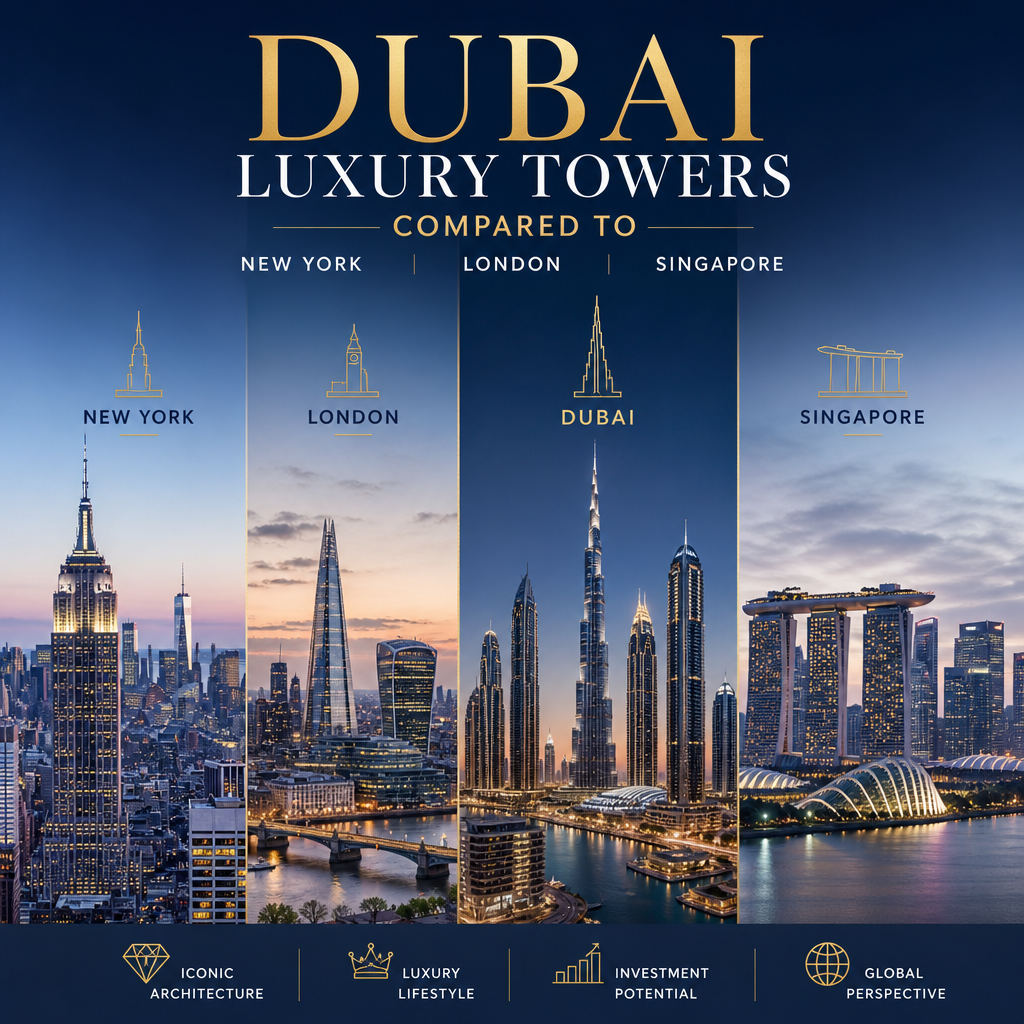
Dubai Luxury Towers Compared to New York, London, and Singapore
How Dubai’s Luxury Towers Compare to New York, London, and Singapore
Luxury towers in Dubai, New York, London, and Singapore share the same ambition: to pair a prestigious address with exceptional views, design, and services. Yet each city gives high-rise living a different character. Dubai emphasizes scale and resort-style amenities, New York offers urban energy and variety, London blends modern apartments with historic surroundings, and Singapore prioritizes efficient design within a carefully planned city.
Understanding these differences can help buyers and renters look beyond a striking skyline and decide what luxury means to them.

Dubai: Space, Services, and Skyline Views
Dubai’s luxury towers are known for their dramatic architecture and expansive amenities. Developments in Downtown Dubai, Dubai Marina, and Palm Jumeirah may offer swimming pools, gyms, concierge services, residents’ lounges, and dining or retail within the building or nearby.
Apartments often feature large windows and views of landmarks, the sea, or the city’s rapidly changing skyline. Newer projects may also include spacious layouts, private lifts, landscaped terraces, and wellness facilities.
A major distinction is the lifestyle surrounding the tower. Many buildings are designed as self-contained destinations, with residents able to work out, relax, dine, and entertain without travelling far. The trade-off is that the experience can vary significantly by neighbourhood: a lively waterfront address feels very different from a quieter residential district.
New York: Variety and an Unmatched Urban Pulse
New York’s luxury residential market ranges from historic prewar buildings to glass-clad supertalls. Manhattan remains the best-known hub, but high-end towers and residences are also found across Brooklyn and other boroughs.
Compared with Dubai, New York luxury often places a stronger emphasis on location and access to the city’s cultural life. A home might be valued for its proximity to Central Park, restaurants, galleries, offices, and public transport as much as for its amenities. Buildings may offer doormen, fitness centres, pools, and private dining rooms, but the package depends heavily on the property.
Space can be more constrained than in many Dubai developments, especially in central neighbourhoods. Views and finishes may be outstanding, but buyers should pay close attention to layouts, building fees, and the age and maintenance history of the property. New York’s appeal lies in immersion: the tower is a private retreat within a dense, constantly active city.
London: Contemporary Living in a Historic Setting
London’s luxury towers combine contemporary construction with a city shaped by centuries of architecture. High-end developments cluster around areas such as Canary Wharf, Nine Elms, and the City, while many affluent residents also choose low-rise homes in established neighbourhoods.
The tower experience can feel more restrained than in Dubai. Buildings may provide concierge services, gyms, residents’ lounges, and landscaped spaces, but local character and access to parks, transport, and heritage districts often carry equal weight. Views might take in the Thames, historic landmarks, or the modern financial district.
Buyers should also consider London’s building regulations, service charges, and the differences between neighbourhoods. A new riverside tower can offer a very different atmosphere from an apartment near a traditional garden square. Luxury here often means combining modern convenience with a strong sense of place.
Singapore: Efficient Design and Green Urban Living
Singapore’s high-rise residences are shaped by limited land, careful planning, and a strong focus on liveability. Luxury developments may feature pools, landscaped gardens, gyms, security, and shared spaces designed to make everyday life convenient.
Compared with the other cities, Singapore stands out for integrating greenery into dense urban development. Residential towers often sit near parks, waterfront paths, shopping centres, or public transport, reflecting the city’s emphasis on connectivity. Interiors tend to prioritize practical layouts and efficient use of space, though top-tier residences can also offer panoramic views and high-end finishes.
Singapore’s rules and ownership conditions can be important considerations for international buyers. As with any market, the details depend on the property and buyer’s circumstances, so professional advice is essential.
What Sets the Cities Apart?
The differences become clearer when comparing the everyday experience:
- Dubai: Resort-like amenities, newer buildings, and generous views.
- New York: A wide range of architectural styles and immediate access to urban culture.
- London: Modern towers alongside historic neighbourhoods and landmarks.
- Singapore: Efficient planning, strong connectivity, and greenery within a dense city.
No city is automatically the best choice. A buyer seeking extensive on-site facilities may be drawn to Dubai, while someone who wants a home woven into a busy cultural scene may prefer New York. London appeals to residents who value historic context, and Singapore suits those attracted to order, accessibility, and thoughtfully planned urban living.
Choosing the Right Luxury Tower
When comparing luxury towers, consider more than height or architectural design. Look at the building’s management, service charges, available amenities, privacy, transport links, and the surrounding neighbourhood. Also think about how you want to spend an ordinary day—not just how the property looks in a photograph.
Ultimately, luxury towers in Dubai, New York, London, and Singapore reflect their cities. The best choice is the one that matches your priorities, whether those are space, convenience, cultural energy, architectural character, or a calmer, greener urban environment.
